
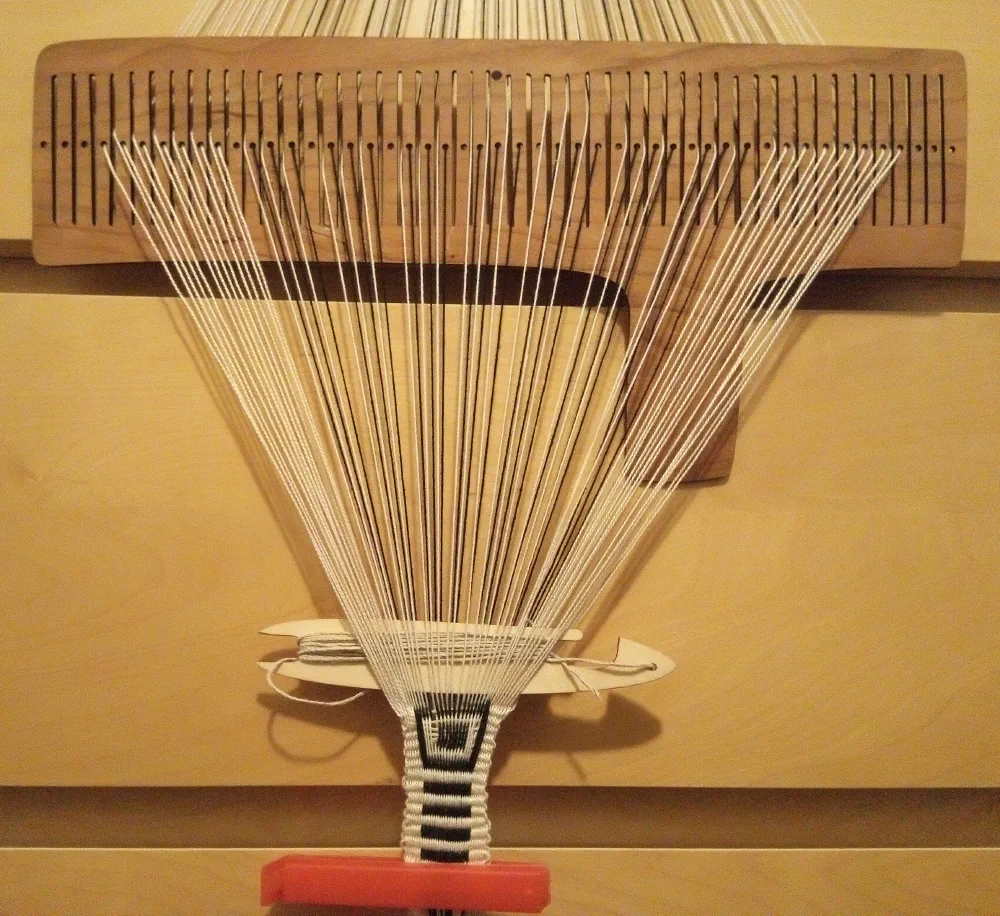


Session #11 is when work started on Band #5. Session #11 is also the first time weaving with Heddle #2.
Ladder infra-structured bands
There is an interesting coincidence between the physical structure of woven bands and the visual structure of rMQR codes which might be put to good engineering use: they both have structure along the long edges. This coincidence should be explored: perhap best thought of as a physical ladder infra-structure underlying better encoding of a band’s rMQR code’s visual data structure.

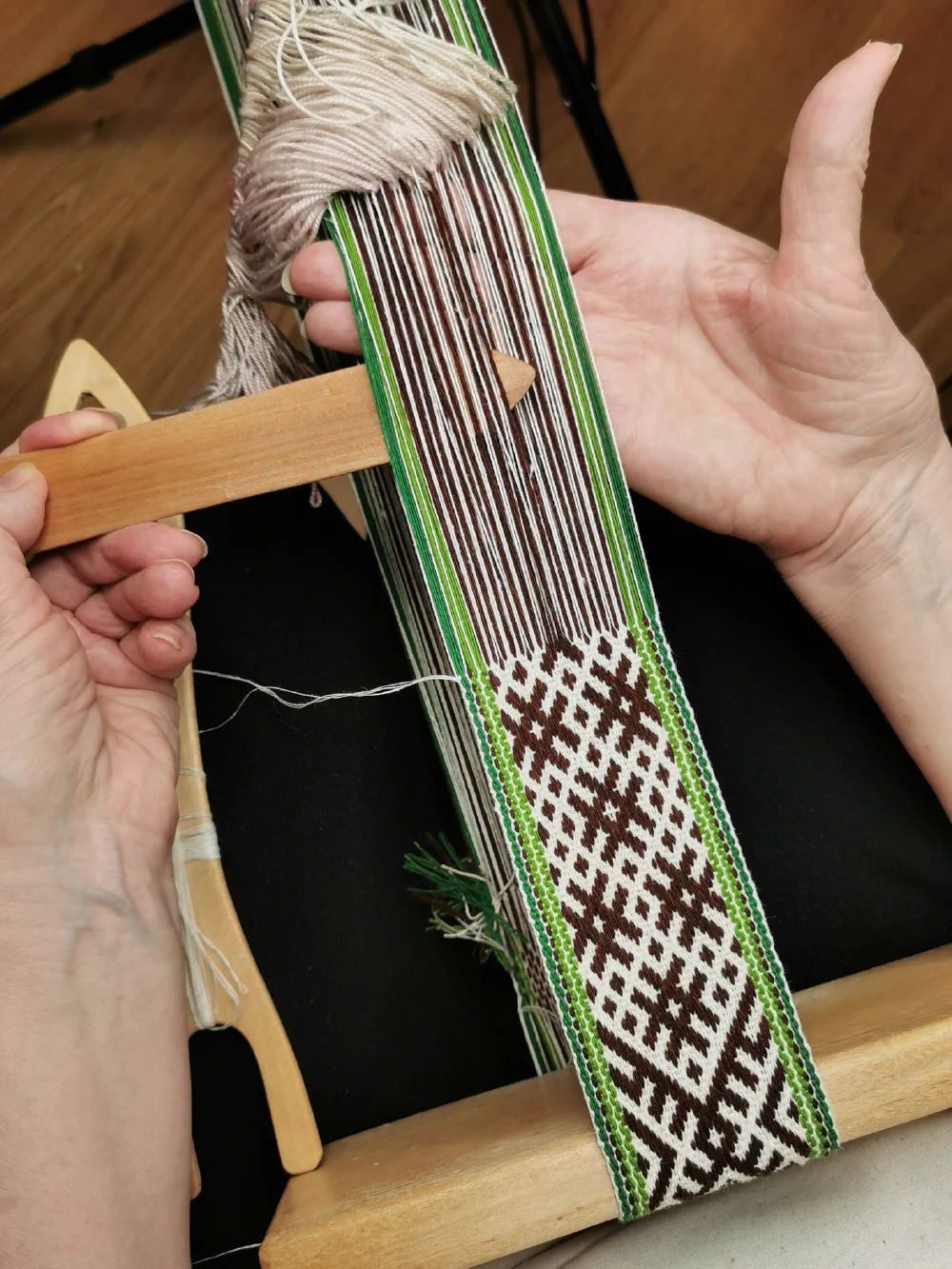
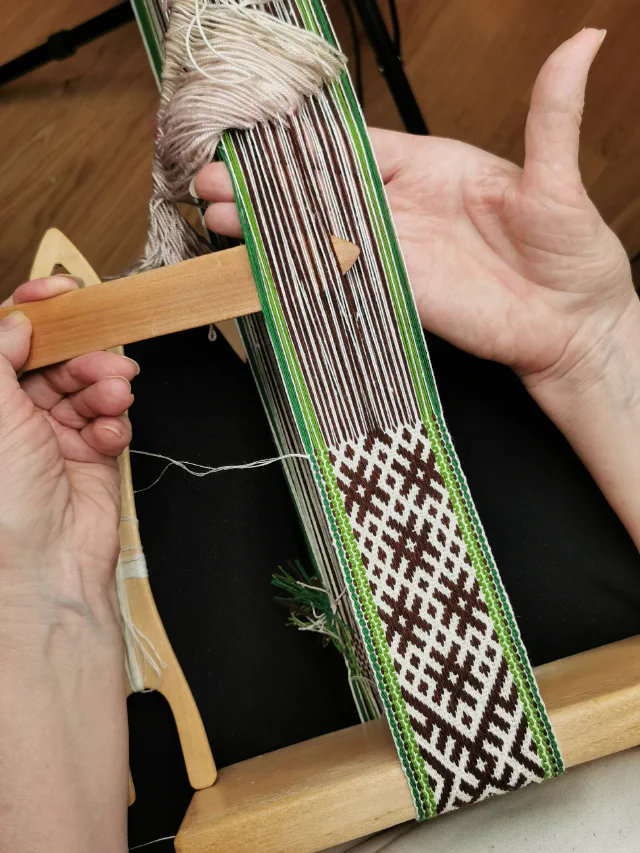
Stronger warp threads on the edges of a rMQR ID band might make for more readable QR codes. Such would be analogous to having strong side rails on a ladder. To visualize such warp patternings, refer to the following band and imagine if each green warp were thicker than the rest:
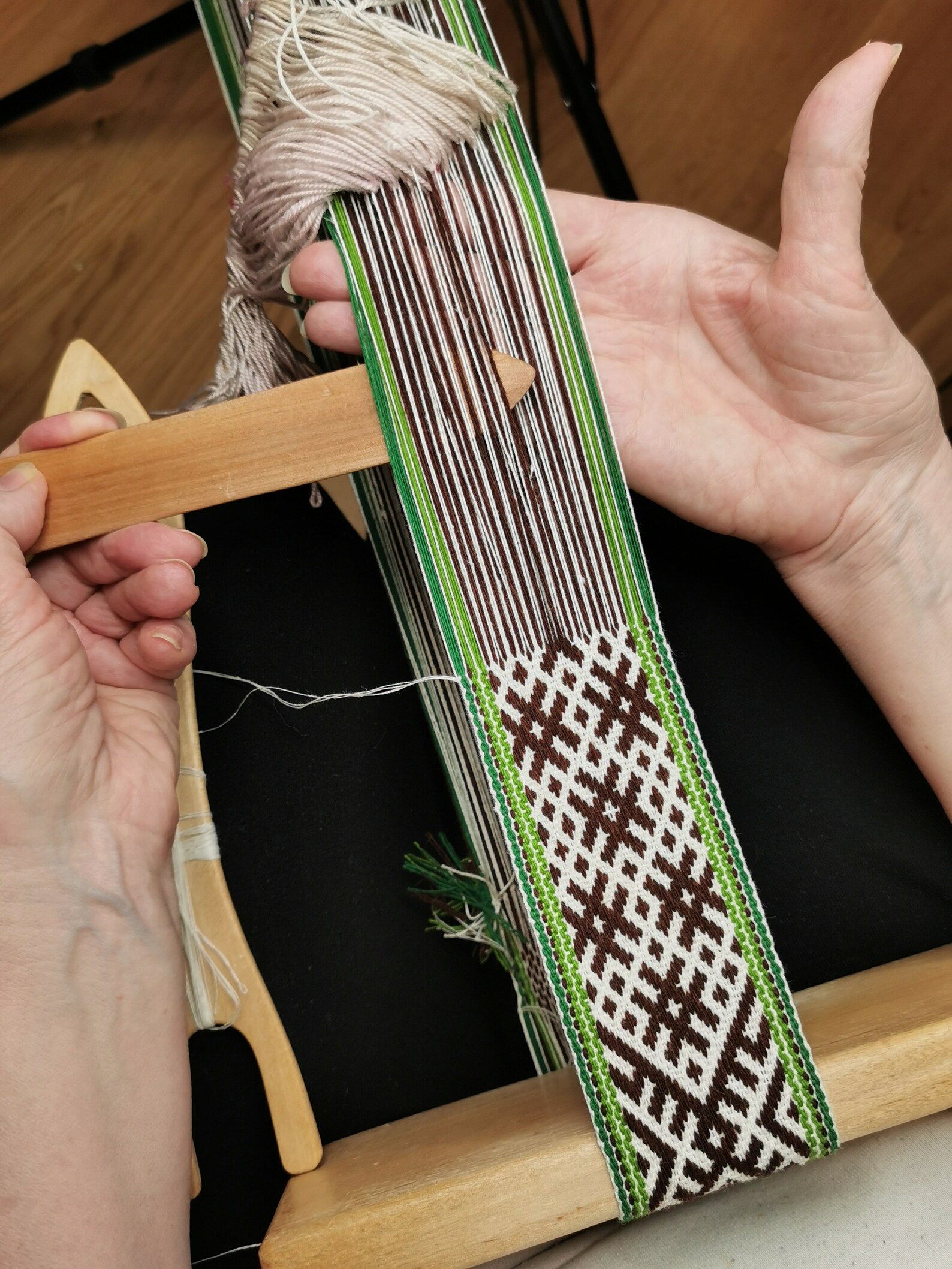
An interesting variation beyond simply using stronger-thicker thread for the quiet zone edge warps, might be to also have stronger-thicker threads in the warps that make up the two outer rows of QR modules (think: wider, stronger side rail of the ladder). Having that part (the timing patterns) rectilinear and evenly spaced would probably increase scanability, because those two always contain the on-off-on-off timing pattern as required by the spec and illustrated above along the top and bottom edges.
Band #5 started
In Session #11, Band #5 was started. Band #5 is an R7-wide rMQR band with each QR module rendered 3 warps wide, using size 10 warp threads.
By definition double faced warp weaving has warp threads that come in pairs, of which one of the pair will always be on the opposite side of the band as its pair partner (this fact is why double faced bands always have the same pattern on both faces, one the inverse of the other).
As Band #5 uses a double faced warp weave, “modules rendered 3 warps wide” requires 6 warps per QR module. Within a given QR module, all 3 warp pairs will show the same color on a face, thereby making a single module.
Since rMQR bands are monochromatic by design, each warp pair will have 1 dark and 1 light thread, in other words 3 black and 3 white per each QR module, a six adjacent to each other.
Six adjacent warp ends (3 blacks and 3 whites) per QR module would require a heddle with at least 66 dents in order to weave an R7-wide rMQR. An R7-wide rMQR code actually require 11 not 7 module of band width: the core 7 modules wide code + 2 quiet zone margins each 2 modules wide = a band 11 modules wide. 11 modules X 6 threads/module = 66 threads.
As such, the warping plan for Band #5 is symetrical left-to-right:
- 13 white, size 5 crochet yarn (DMC pearl cotton ecru)
- 42 warps alternating black and white, all size 10
- 12 white, size 5 crochet yarn
Band #5 is the first experiment involving stronger warp threads in the selvage (the size 5 warps above). The goal hear is to prevent the edges of the band from stretching. So the 12 all white warps on each edge are size 5; these make up the edges of the band which make up the required two QR module wide “quiet zone” around the data encoding part of an rMQR. The warp threads in the middle of the band (where data is actually recorded) are white size 10 and black size 10. The idea is that a large weft thread (1mm) and medium/large warp threads (size 5) creat a sort of ladder struction, and the small (size 10) central warps encode the data more finely, potentially leading to smaller bands.
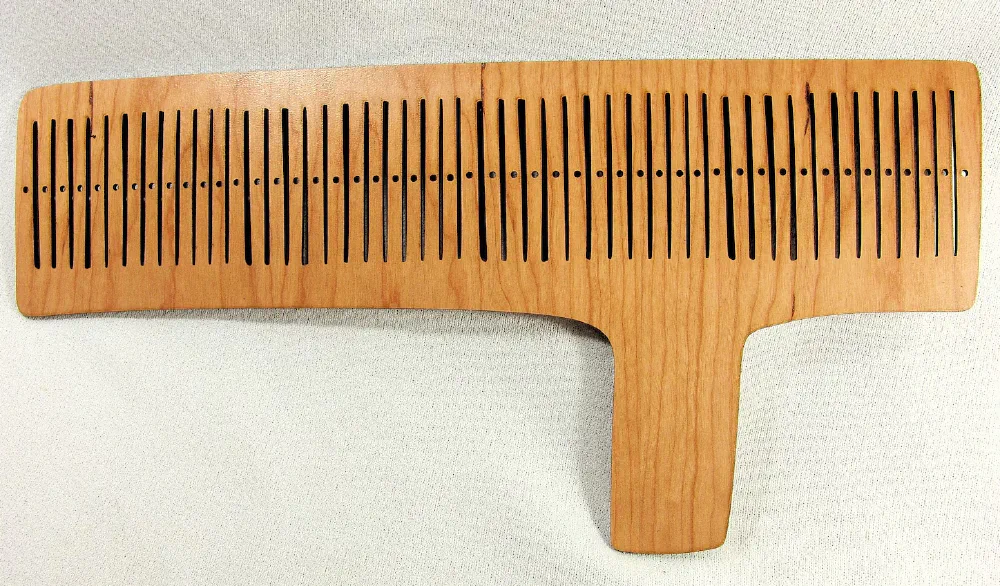
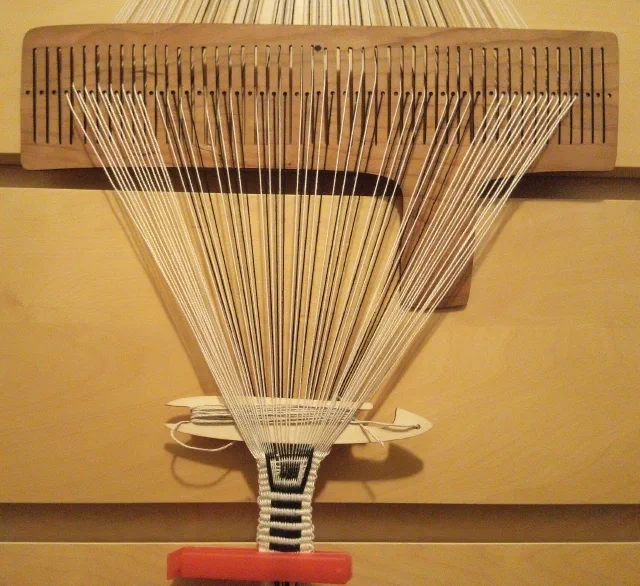
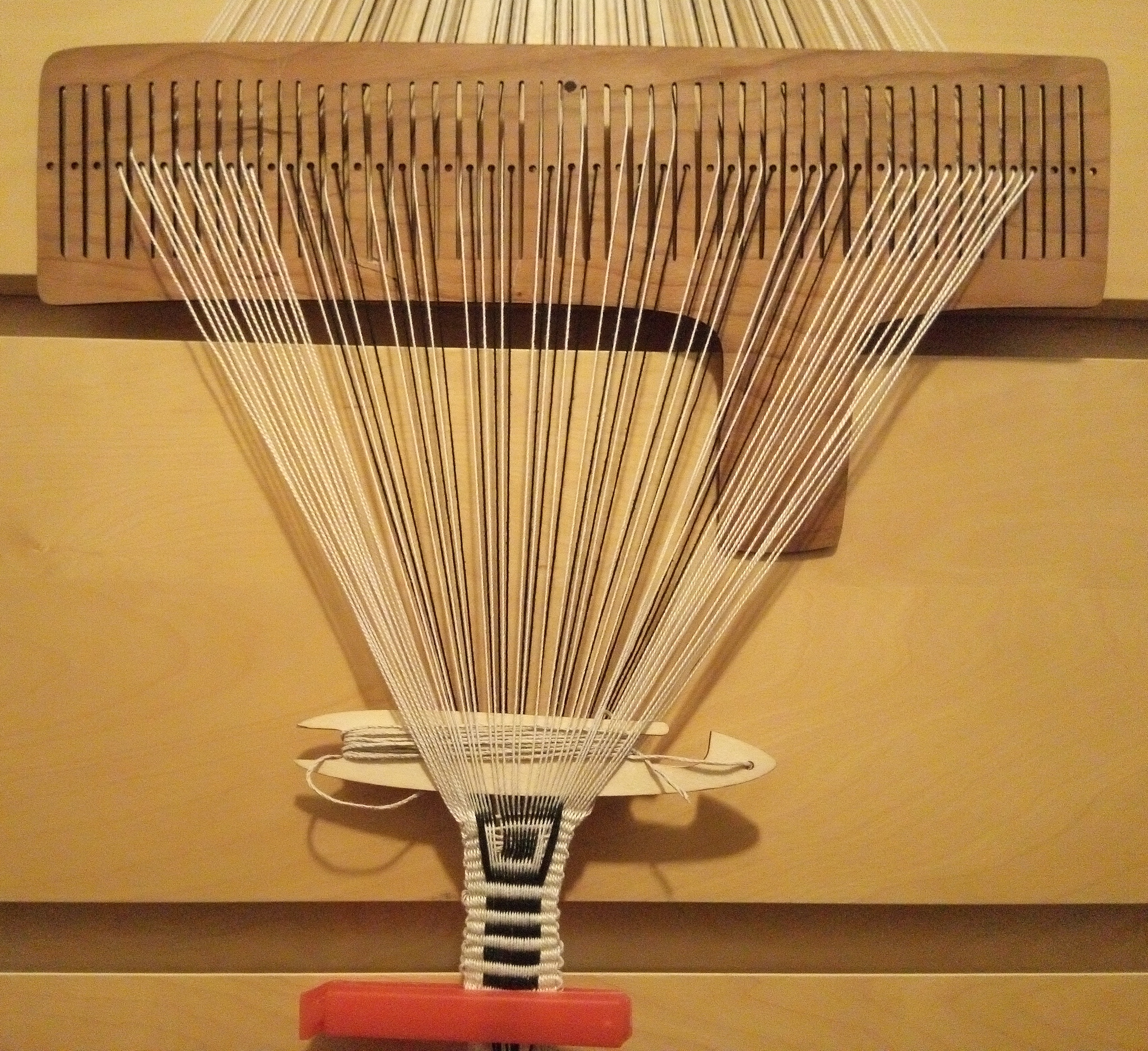
Heddle #2 with 91 dents, up from a max of 31
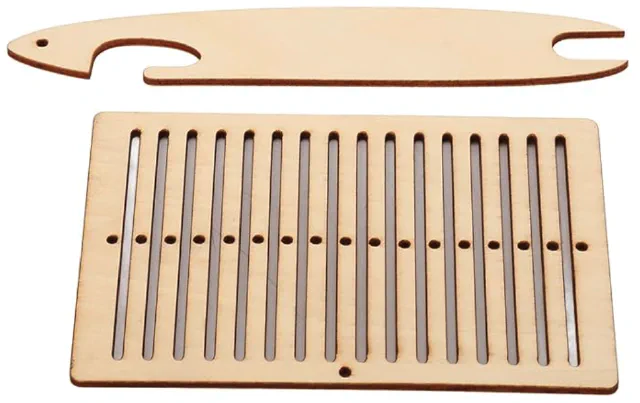
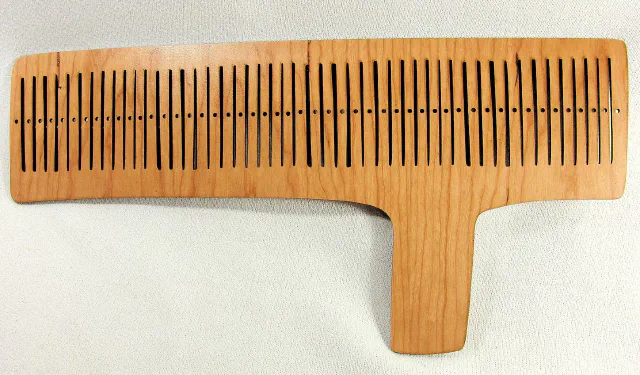
As seen in the first ten bandgrinding sessions, Heddle #1, the first rigid heddle used in these bandgrinding experimens, has 33 dents – 17 holes plus 16 slots.
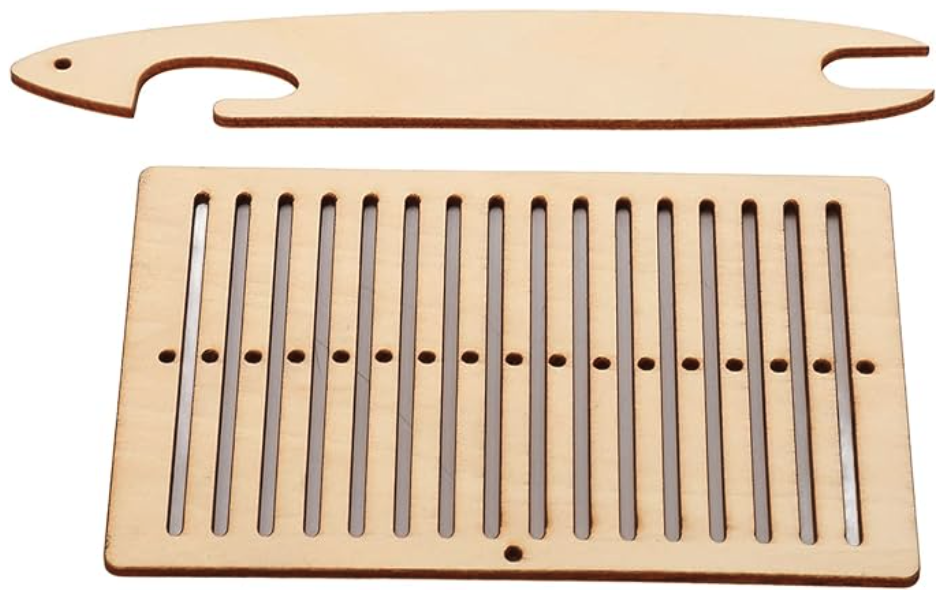
The current experimental goal is to get a QR reader to recognize an R7-wide rMQR handwoven onto a band. The earliest experiments used only one warp thread per QR module. Starting in Session #9, experiments started using three warp threads to render each QR module. At that point, Heddle #1 was not large enough to handle 6 threads per QR module (3 warps on each side of the band means 6 warps per QR module). Heddle #1 has 31 dents, and so can render at most a QR code 5 modules wide. The minimum width on rMQR code is 7 modules. 31 < (6*7). So, Heddle #1 is a deadend for modules 3 warp ends wide.
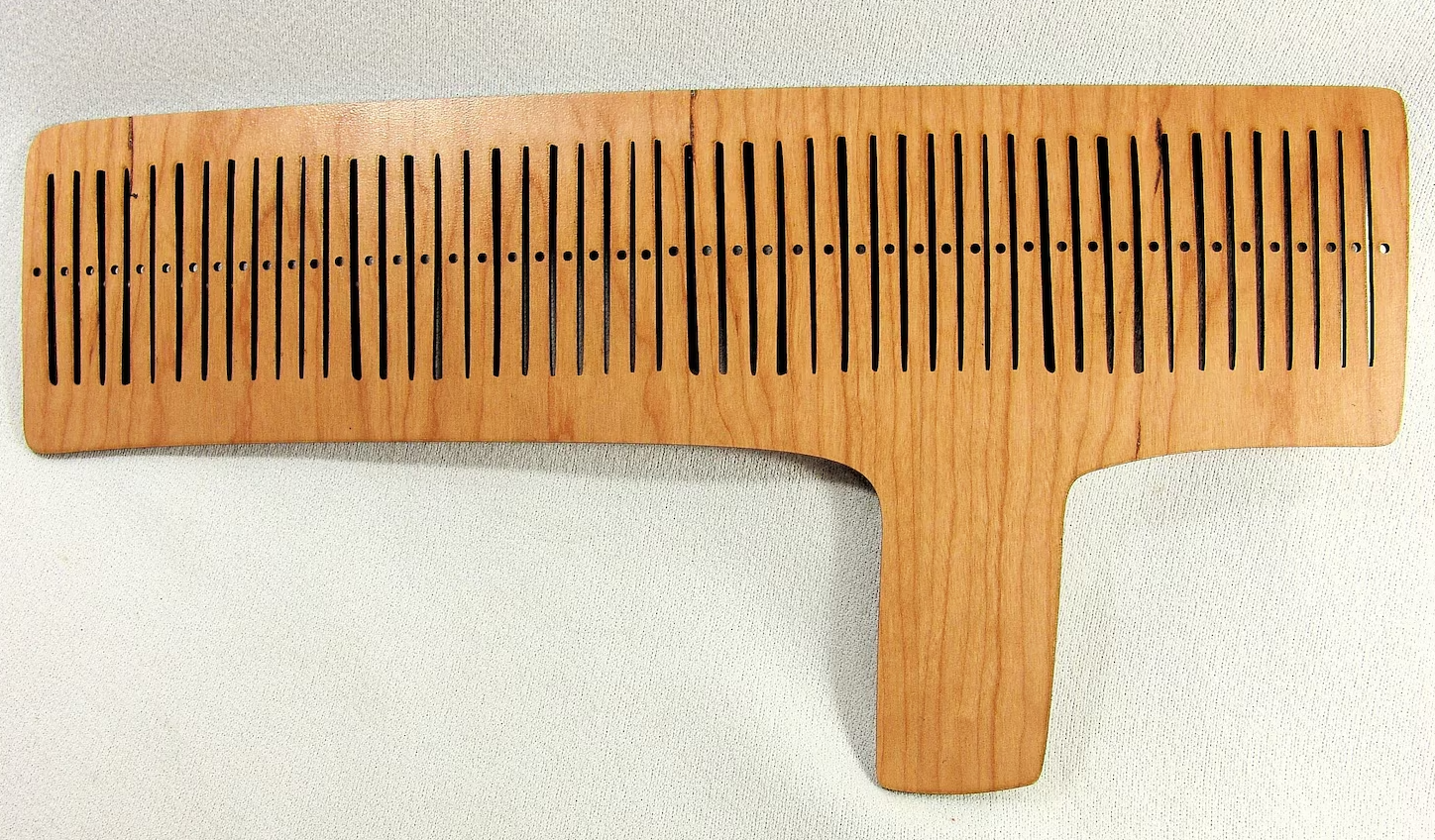
So, Heddle #2 was ordered on [2023-12-11 Mon]. Heddle #1 has 33 dents and Heddle #2 has 91 dents. (Not two two previous pictures not to the same scale.) 91 will be enough to even get wasteful of dents (and experiment with novel heddle designs).