Inbox
This tech allows folks to get that money in the global marketplace without leaving home rather than going to grind in a factory in a big city in nasty working conditions as a wage slave (which nonetheless is a way to get SOME money, just rather unpleasant).
Tech philosophy
“There are two ways of constructing a software design: One way is to make it so simple that there are obviously no deficiencies, and the other way is to make it so complicated that there are no obvious deficiencies. The first method is far more complicated. “– Tony Hoare
The Padonma Network strives for the latter. Further, we believe deeply in Mr. Gameboy’s idea of lateral thinking with weathered technology. Nothing about the Padonma Networks tech stack is novel, except the rMQR variant of QR Codes, the latter having been around since 1994 when the folks at a Toyota subsidiary invented that tech.
Old
Padonma Network
The main takeaway of this project is the Padonma Network which is a global marketplace of lotus fiber, architectured to minimize the power of intermediaries and implemented as free open source software that runs on free Web services like Google Search and GitHub pages.
The goal
The goal here is to engineer a start-up style situation to bootstrap a global supply chain but without building for an outcome like eBay which will devolve via enshitification based on the initial incentive structure. In other words, this is not about the money (well, not for the founders, as would normally be the case for a start-up).
The UX experience
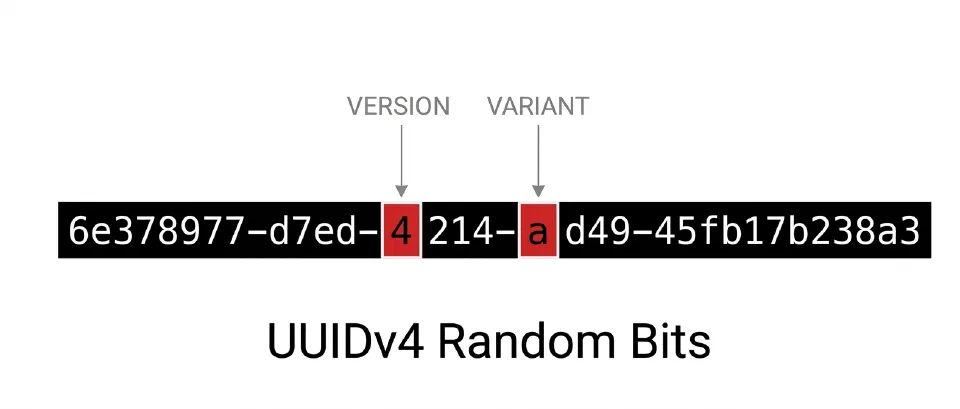
An artisan simply generates a new UUID for each handwoven garment and uses it twice:
- Once as text in a webpage that Google indexes
- Again as bits in a QR Code handwoven into a garment
Later when the QR Code on the garment is scanned it leads to that webpage with the same UUID, which will be the artisans website.
The technical core
From a technology perspective, the Padonma Network boils down to doing UUID look-up via Google Search, where the UUID to look-up is unique to an individual handwoven garment into which that UUID has been woven, encoded in a QR Code.
The core of the Padonma Network is intentionally very simple. It is designed to enable solo entrepreneurs to fully self-represent in a global marketplace at zero cost and without loss of control to unnecessary intermediaries. It has been architected for decentralized control.
The business implications
From a business perspective, the Padonma Network is very much like a traditional textile industry Collective Mark Organization (CMO) such as Woolmark or the Silk Mark Organization, serving as brand and enabling digital coordination. The Padonma Network does self-identify as a CMO, for the modern digital world.
Technically the core of the Padonma Network is simple to understand and easy to participate within, but architecting a marketplace this way has all manner of interesting implications for the power dynamics of the textile industry.
Earlier
once have uuid, can do all manner of fancy stuff, like write it on a piece of paper, put that tame alpanumeric character sequence on a web page that google crawls, blockchain, etc
Philosophy
Padonma (pa don ma) is the Burmese word for lotus. This is the lotus network, directly connecting the lotus spinners and weavers with the ateliers of the world, in a marketplace designed to maintain the identities of the individual artisans who voluntarily join the marketplace for zero cost and zero controls.
It is an explicit goal of the Padonma Network to subvert the power structure of the fashion world. Extreme disintermediation enables this small niche of the textile industry to function like the cottage industry of olden days: skilled artisans working from home (often mothers simultaneously providing at-home child care). Open protocols replace much of the coordination normally supplied by centralized intermediaries.
It is THE global marketplace because it is built on a blockchain controlled by ALL the producers who are members of the blockchain network.
Who defines a garments native ID
If two businesses interact, they will have a mapping between both of their internal systems (which ID all entities). If artisans do not declare an ID for a garment, then that will be defined by the first business to pick up the item. The Padonma Network can be looked at as the absolute minimal technology for a textile artist to bridge between the physical and the digital in an economic system. What would be the absolute minimal “back office” for an artisan. Something along the lines of a blog post or just a single tweet with a picture.
More
The Padonma Network is exploring the possibility of tracking cottage industry garments via handwoven QR codes. The goal is to design the easiest on-ramp imaginable by which a single artisan could make their products globally traceable via handmade QR codes.
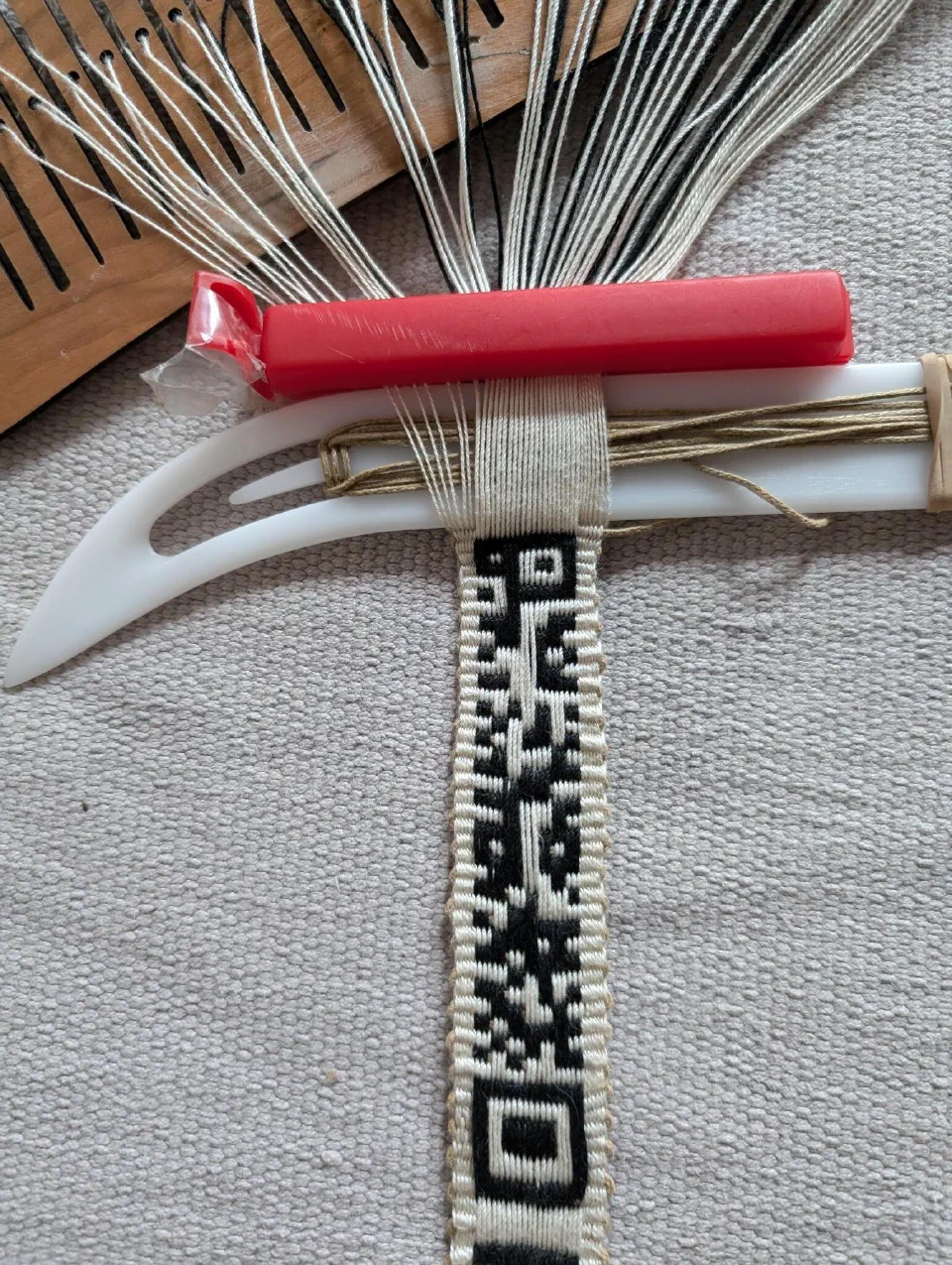
The ancient handweaving technology of the rigid heddle loom seems like it may well be fit for the purpose of handweaving rMQR ID bands. Read the Bandgrind Experiments pages for a log of ongoing experiments into weaving rMQR ID bands via a rigid heddle.
This project is exploring the potential of tagging garments with handwoven labels containing rMQR codes, which are a novel variant of QR codes. The rMQR specification was ratified as an ISO standard in May of 2022. The name “rMQR code” is short for “rectangular Micro Quick Response code.” Whereas original style QR codes are square, rMQR codes are narrow and rectangular, resembling ribbons or bands:

There are many prior examples of handcrafted QR codes being recongized by QR reader software. The relative advantage of rMQR over QR in this project is that while handweaving it is easier to weave seven “bits” per row than the “wider” rows of traditional QR codes, and the machinery required to do so is minimal (fingerweaving would not even require a loom). The goal is to make it as easy as possible for artisans to join the Padonma Network.
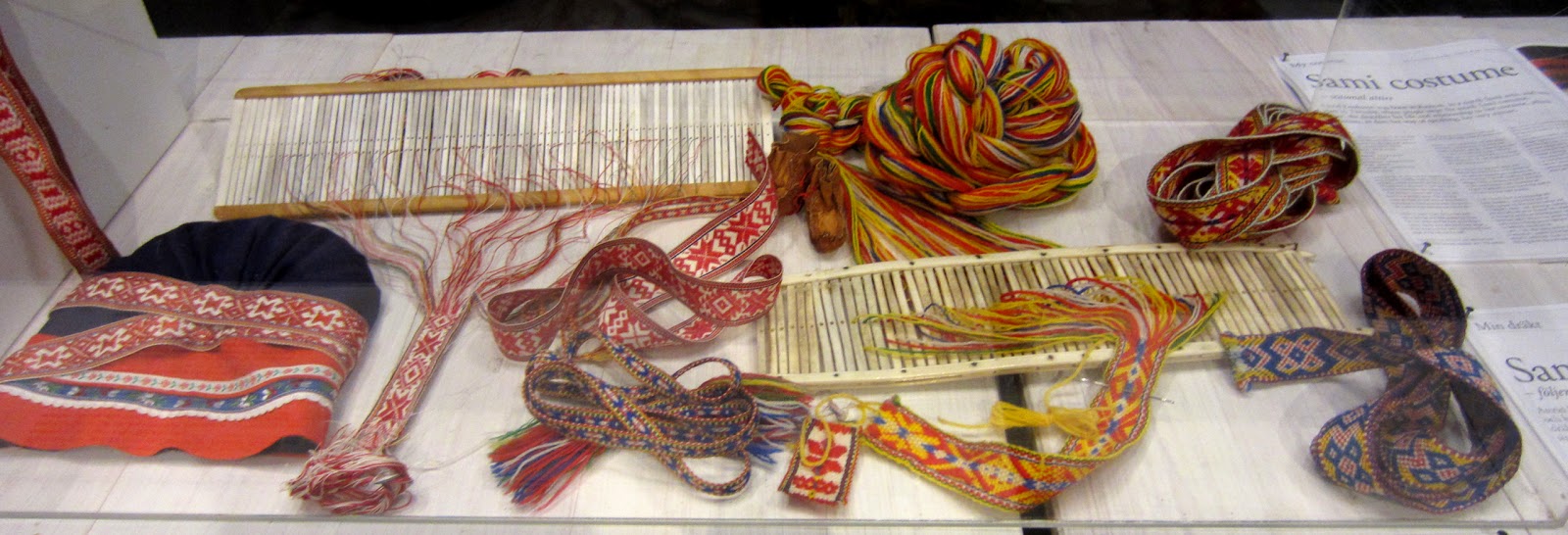
It would seem like an rMQR code such as the one above could be woven into textile bands which would look something like the small band in the following example, but the black pattern “pixels” of the words would be replaced with rMQR code data modules:
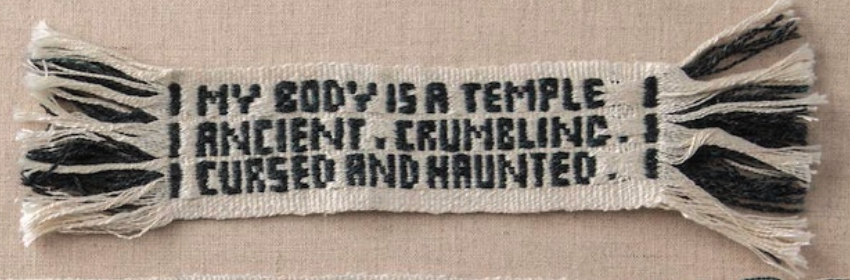
A simple rigid heddle backstrap loom would be sufficient to weave such a band, which would look much like this exaple:
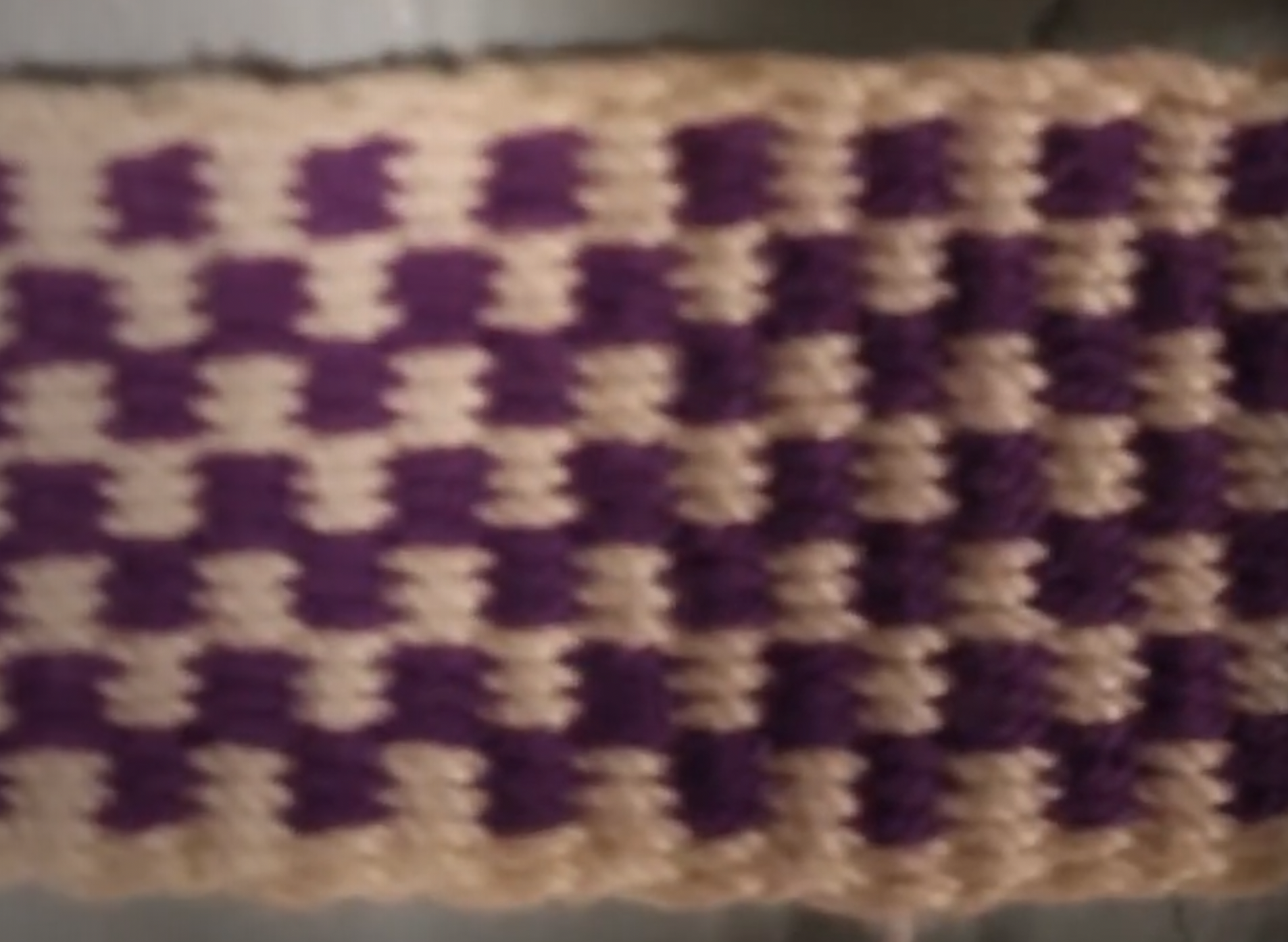
The weaving term “letter pick-up” refers to using pick-up techniques to weave letters into bands. So this Padonma Network project is trying to work out “QR code band pick-up weaving,” or more succinctly “QR pick-up.”
Proposal
This proposal has a hardware part and a software part.
The hardware part is the bands with UUIDs encoded into rMQR codes handwoven into them, which in the Padonma Network are called “rMQR ID bands.” Each garment has a unique UUID encoded in the rMQR code on its ID band.
The software part is using a garment’s unique UUID ID to represent the garment in the digital domain. The same (UUID) ID can be used consistently across both public and private databases. The same tag would be used in both context.
For an example of private database, artisans could track their inventory privately in a spreadsheet using the UUIDs. And when a garment leaves from its place of manufacture the same UUID will represent it outside in the wild. For an example of public database, a blockchain could be used solely as a public domain global inventory tracking system (not cryptocurrencies but garments will probably have NFTs that contain garment UUIDs), using the same UUIDs to represent garments globally.
Both parts of this proposal are addressed in the following subsections:
Blockchain for Fashion
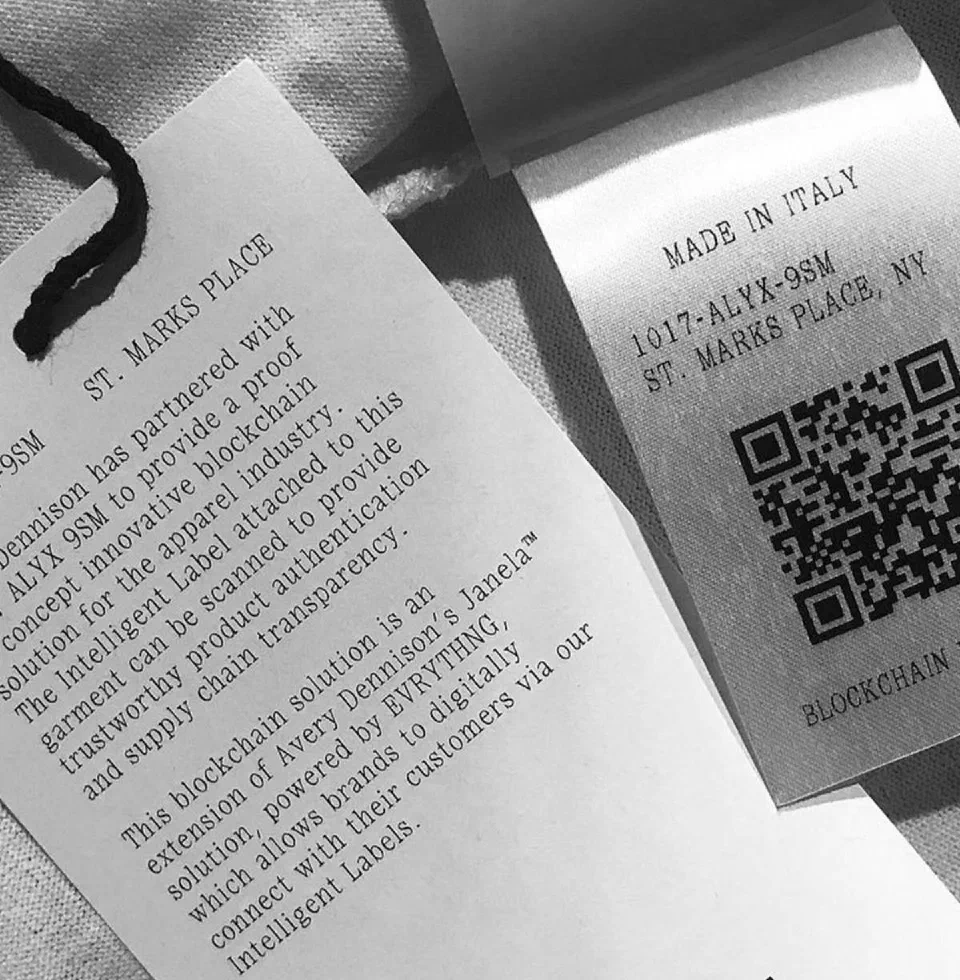
summary: India is already blockchain tracking handloomed sarees with embedded QRs
QR codes can encode any arbitrary digital data. In the use case of Padonma, the QR code will encode the unique digitial ID of the garment into which it is sewn. For Padonma, the digital ID data standard used is called UUIDs, short for Universally Unique Idenfifiers. The garment IDs can be tracked in a distribute inventory system, which for the Padonma project would be implemented using blockchain technology.
In other words, the handspun QR code encodes the ID of the garment’s unique NFT. The NFT is simply the unique ID of the garment in the distributed global inventory tracking system, which happens to be a blockchain. (There are no overpriced JPEGs in this blockchain use case.) This is how a handcrafted garment can be tracked in a global inventory system as the garment travels the global supply chain.
A garment’s physical tag will have its QR code handwoven into the fabric, using simple techniques to make what weavers call bands (or narrow wares, or ribbons). The encoded IDs correspond to NFT IDs, each garment has its own NFT. The NFT is simply for inventory tracking identity, think of it like a digital passport for the garment. This is not a silly collectors game based on overpriced JPEGs. The NFT gives the garment an identity in the distributed database that is the blockchain, which serves as the inventory tracking system.
Each garment will have its own unique rMQR tag and own unique NFT. A collection of such NFTs tracked on a blockchain are the distributed equivalent for a factory inventory system that could span the entire supply chain.
Conclusion
The current goal is simply to prove that handwoven rMQR codes can be easily scanned by mobile phone. Weaving experiments are currently being done to figure out the cheapest, easiest, and quickest way to handweave rMQR bands.
Once a garment is tagged with an rMQR band with a unique UUID encoded in its QR code, all manner of interesting things can be done. The rMQR band tags the garment with a unique UUID, and that UUID is the garment’s unique identity in the digital world.
“Rem QR ID band”
blockchains using rMQR tags.
As an example of one manner of interesting thing to do with rMQR ID bands, the Padonma Network project hopes to explore globally tracking garments via distributed web technnologies.
Perhaps web5 might be an elegant solution – something involving blockchain for public info, and artisans storing their private data in DWNs (web5 DWNs data packbacks).
And the UUID in the rMQR ID band it what connects the garment’s identity in the public web, the blockchain, and the DWN private database.
Once inventory is on a blockchain, paying for garments with, say, Bitcoin is certainly possible. Surely it should be possible to pay for a garment by exchanging Bitcoin for a garment NFT. (Via web5?)
In India, the government already encourages paying for QR coded handloom objects via digital money: QR Codes in Handloom and Handicraft Industry: Make It More Vibrant:
Also, The Ministry of Textiles, Government of India, promotes digital transactions using BHIM app or Bharat QR Code. Bharat QR Code is one of the most popular QR Code-based mobile banking apps in India.
But the Padonma Network should use an open source blockchain to be run publicly by artisans on their Android phones. And the only actually valuable cryptocurrency is Bitcoin so, web5? (What does a decentralized, blockchain-related, network-of-trust based global inventory system working in a networkless jungle look like? A blockchain network that keeps falling apart yet somehow comes to consensus? Each (Android) node would run its own web5 inventory app? Et cetera.)