
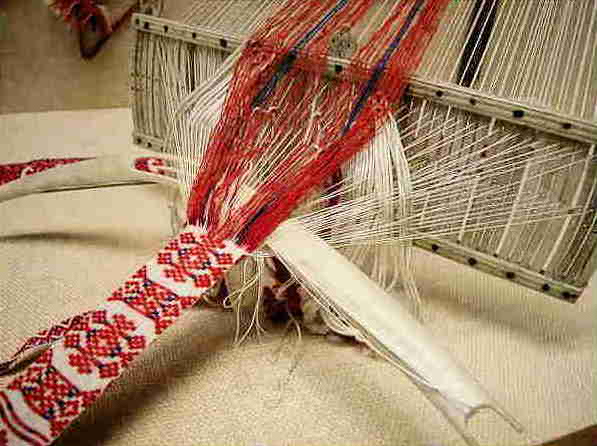
Bandweaving is an ancient weaving technology.
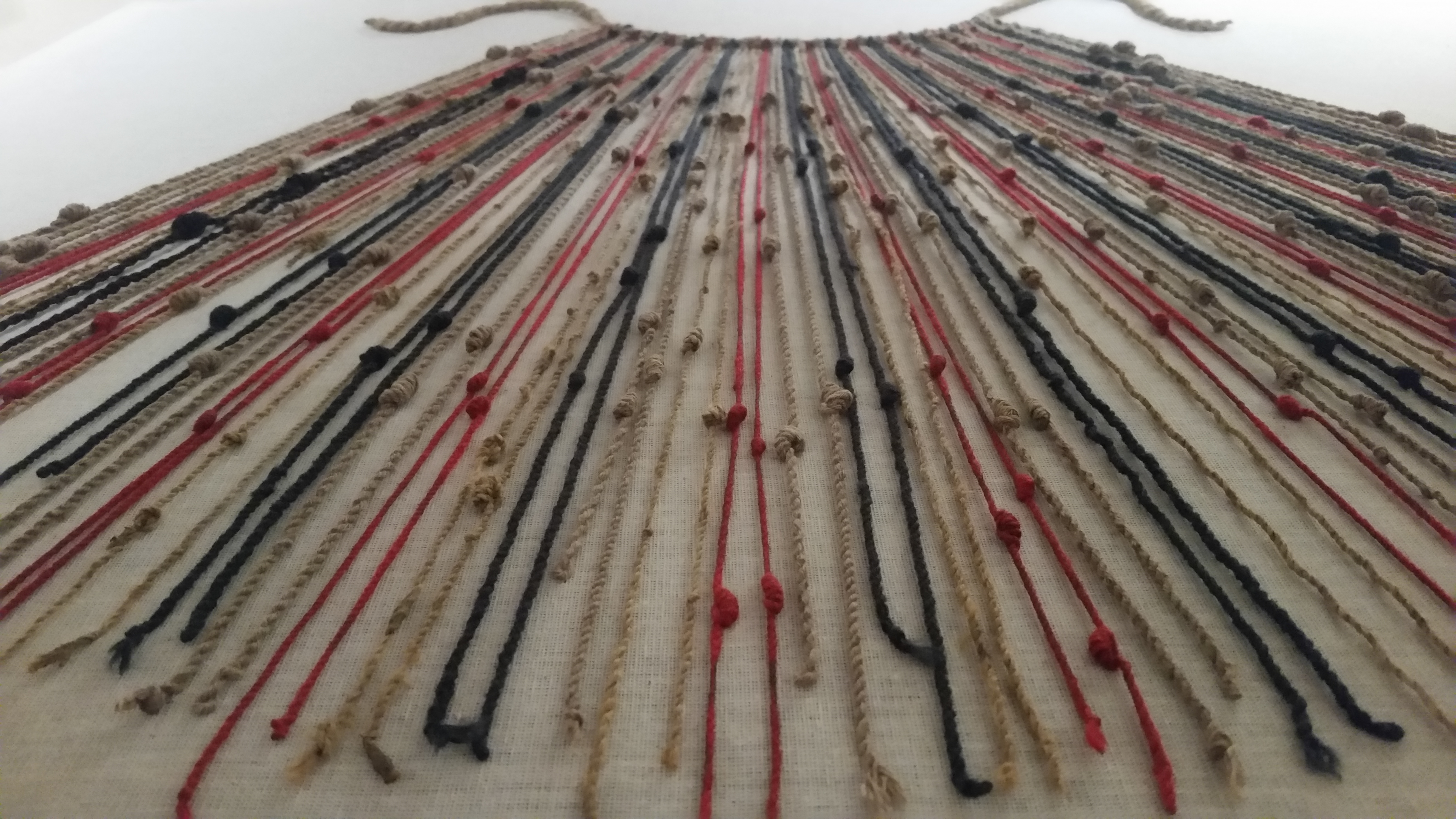
Completely separately, recording data in threads (interwoven and/or knotted) is also an ancient technology. For example the bean counters of the Incan empire went about their business using quipu, data recording devices fashioned from systems of knots on strings.
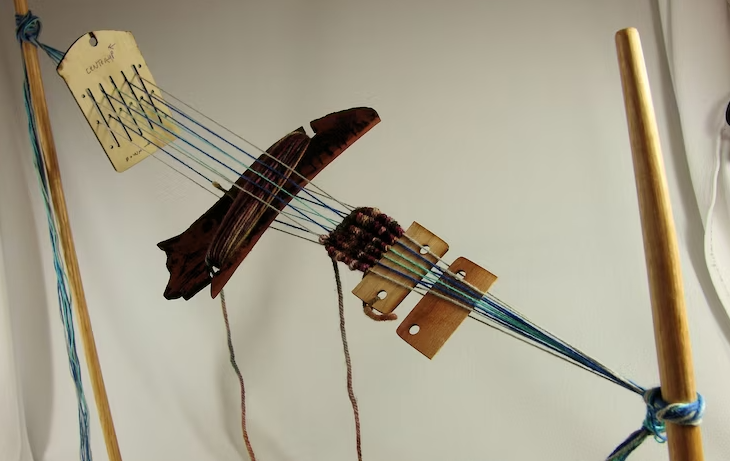
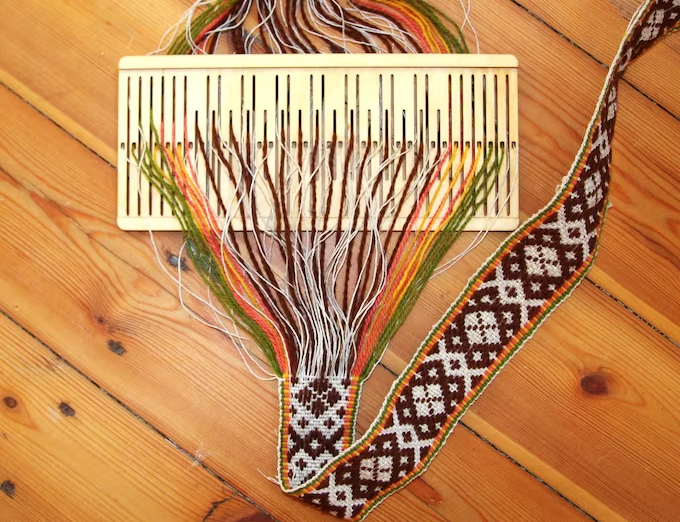
A bandweaving loom is about a simple as looms come, requiring only a small sheet of wood (called a rigid heddle as seen above) and thread, of course. In an extreme case, a rigid heddle loom could be constructed completely by hand, for example see How to Make Your Own Backstrap Loom. To weave a band, a rigid heddle backstrap loom is all that is required:
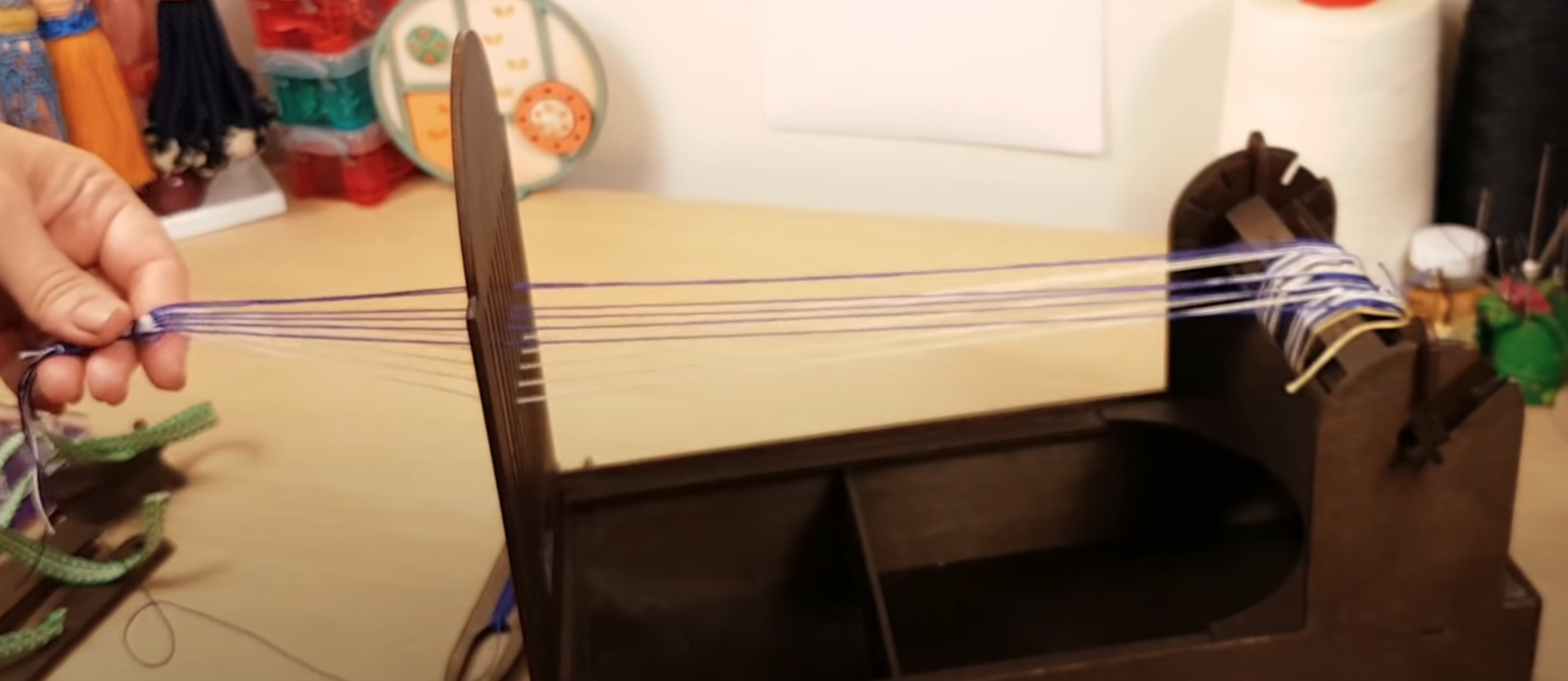
The above loom demonstrates that the barrier to entry to bandweaving is very low. More sophisticed looms enable producing bands faster at higher quality. For example there are task-specific stand alone tape looms where the heddle is integrated into a box frame loom:
Bandweaving can seemingly be easily adapted to pattern QR codes into small handwoven tags. In weaver’s jargon, such tags are referred to by terms such as band, tape, ribbons, or more generally as narrow ware. In the Padonma Network, the term “band” has been selected, etymologically following the Sweeds, who use the word “bandgrinds” for rigid heddles, as in a bandgrind is a machine for grinding out bands.
Such ID tagged bands could be sewn into garments without disrupting the original design of a garment. Optionally an rMQR code code be added into the weave of a fabric using, for example, “supplimental weft” techniques. Once tagged such a garment could be digitally tracked through supply chains, yet an artisan would require no sophisticated computer control tooling, nor even power tooling, to join such a global economic market.
Each garment would have a unique QR code woven and/or sewn into it. Since each QR code would be unique to a specific garment, each garment would have a unique ID number assigned to it by its QR code. For the Padonma Network, the QR codes would just contain a UUID, a Universally Unique Idenfifiers. UUIDs are globally unique IDs that are 16 bytes of data in size. That is small yet a UUID is all that is needed for global digital inventory tracking. The smaller the data encoded, the quicker the tags can be handwoven.
The specific variant of QR pattern to be handwoven for Padomma is called an rMQR code (etymologically, “rMQR” expands to r-M-QR, or “r"ectangular-“M"icro-“QR”). The rMQR standard, ISO/IEC 23941, was ratified in May of 2022. An rMQR ribbon that is seven or nine “pixels” wide is easier to weave by hand, when compared to “traditional” square QR codes which are 21x21 or 29x29 module (“pixels”) in size. A R7x77 rMQR could encode a UUID, that is, could store 128 bits of data.
There are easy to use tools on the web that anyone can use to generate rMQRs, for example, Online rMQR Generator. For software developers, open source software source code is available to implement rMQR readers and writers that could work off-line in web pages: https://github.com/cozmo/jsQR
With simply these handwoven QR codes, handmade garments could be tracked globally throughout supply chains. In Padonma, the barrier to entry to join such a global supply system has been intentionally designed to be minimal, requiring only extremely minimal weaving machinery. A simple rigid heddle loom ( a piece of flat wood about the size of a flashcard) and thread in two colors is all the capital investment required, all of which could be manufactured by a single weaving artisan, from spinning thread to carving a heddle.